The lab workbench.
Practice the trust and reliability boundaries locally, then extend the design into a verified Databricks environment.
Run the local reference lab
cd support-copilot-lab
python3 copilot.py
python3 -m unittest -v
Expected behavior: Alice sees the Department A policy with citation a-01@2. An approved update resolves ticket T-101 at version 2. Retrying the same operation returns the same result. Twenty tests exercise allowed behavior, denied access, changed approvals, expiry, stale state, and idempotency.
Four investigations
| Exercise | Change to investigate | Evidence to produce |
|---|---|---|
| 1 · Authorized evidence | Compare Alice, Bob, and an unknown actor. | Allowed and denied document IDs; source-backed answers. |
| 2 · Approval boundary | Try execution without approval, with expiry, and after changing the payload. | Denied writes with no unintended side effects. |
| 3 · Reliable retry | Repeat one operation; then reuse its key for another payload. | One audit event for the legitimate operation; mismatched reuse rejected. |
| 4 · Recovery and change | Change resource version or permissions before execution. | Stale or revoked actions rejected; recovery plan explained. |
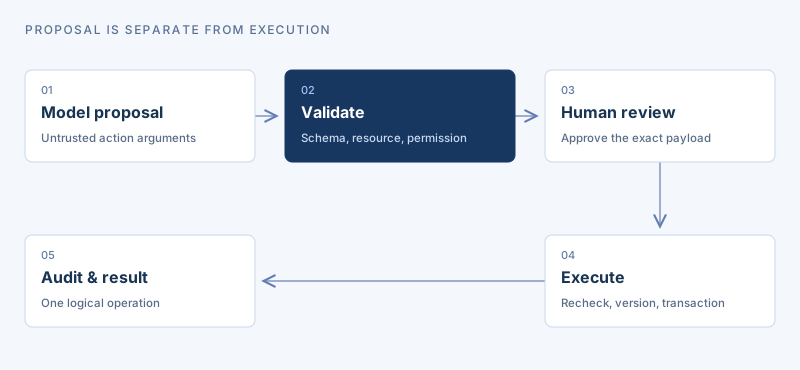
Understand the reference boundary
The lab uses a trusted in-process identity fixture and a local SQLite transaction. It has no login service, production HTTP API, model provider, or distributed transaction. A production adapter must supply verified identity, supported API semantics, durable operation tracking, and reconciliation across services.
Run the tests first, inspect the code, then change one behavior at a time. The test suite demonstrates the stated fixture cases; it is not a proof of universal security.
Managed Databricks extension
| Before you begin | Record or verify |
|---|---|
| Environment | Cloud, region, workspace, runtime, and feature availability. |
| Identity | Users, service principals, deployment identity, permissions, and revocation. |
| Data/search | Authoritative tables, index choice, synchronization, and deletion behavior. |
| Model/evaluation | Supported model interface, MLflow setup, dataset, and trace access. |
| Budget | Current pricing sources, resource limits, expected usage, and cleanup. |
| Evidence | Executed checks, outputs, failures, versions, and remaining unverified steps. |