See the system
Release a reproducible application with deliberate identity, networking, configuration, and recovery choices.
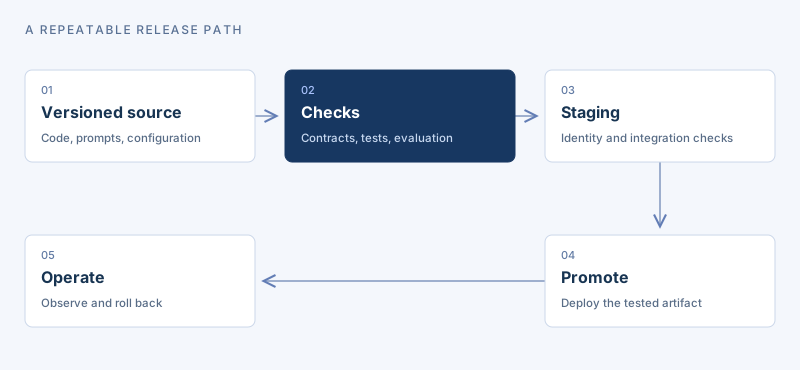
Choose an appropriate runtime
A notebook is useful for exploration but is not automatically an operational service. Choose a runtime that fits request duration, dependencies, scaling, networking, identity, and the client’s platform. Managed application and serving options can reduce some operational work but introduce their own constraints.
Document what the runtime owns and what your team owns. Avoid adding containers or orchestration systems solely for appearance; choose them when the workload or existing environment warrants them.
Package for reproducibility
Pin dependencies and record the interpreter/runtime. Separate build-time files from runtime configuration and secrets. Include health checks that reflect the service’s readiness without making every check expensive or exposing internals.
A clean-environment setup test often reveals hidden assumptions. Keep data initialization and migrations deliberate. Do not require an undocumented manual notebook step for every release.
Define network and identity boundaries
Record inbound users, outbound dependencies, identity flows, and data locations. Verify that the deployed service can access only what it needs and that users cannot bypass its access policy through another exposed endpoint.
Network restrictions complement application authorization; neither replaces the other. A private endpoint can still receive an unauthorized request from an internal user. Review operational access for maintainers too.
Separate configuration from code
Environment-specific URLs, resource identifiers, quotas, and feature switches should be explicit configuration. Validate required settings on startup. Keep secrets in the approved platform mechanism, never in published lab files.
Infrastructure/configuration as code makes review and recreation easier, but can also apply destructive changes. Inspect target resources and migration effects before deployment, especially when importing existing systems.
Verify release and cleanup
Smoke tests should exercise a critical read, an expected denial, and a safe representative workflow after deployment. Rehearse rollback against compatible data and configuration. Identify any actions rollback cannot reverse.
A lab should include teardown and verify that billable resources are removed or stopped as intended. Record what was actually deployed. A local demo is useful, but must not be described as a completed managed-platform release.
Worked scenario
A deployment succeeds, but the application uses a development catalog because a configuration value was copied incorrectly. A post-release smoke test should inspect a harmless known fixture and confirm the environment identity and expected access boundary. A process exit code alone cannot establish correct deployment.
Practical assignment
- Choose a runtime and document reasons.
- Package the local reference application.
- Define deployment-specific identity and resource configuration.
- Run a clean setup and smoke test.
- Rehearse rollback or write the exact managed rehearsal plan.
- Record resource cleanup and unverified environment-specific steps.
What to submit
Submit the artifacts named above, a short explanation of your decisions, and evidence of the checks you performed. Distinguish measured results from estimates and designs from executed integrations.
| Review dimension | Submission evidence |
|---|---|
| Correctness | Show the expected behavior and a meaningful counterexample. |
| Reproducibility | State setup, inputs, versions, and what was actually executed. |
| Delivery judgment | Explain the client impact, alternative, and unresolved assumption. |
| Operational boundary | Identify permissions, failure behavior, and any resource cleanup. |
Knowledge check
Answer guide
- No, verify the actual user path and environment. A deployment can succeed with incorrect configuration or permissions.
- In an approved secret mechanism. Secrets require appropriate storage, access, and rotation.
- No. Internal callers still need an appropriate access decision.
References & next step
Platform examples are environment-dependent. Start with the official documentation in the reference library and verify the exact cloud, region, privileges, and versions you use.
Open the official reference library
Editorial edition: 5 October 2026. The local reference lab is executed locally; this course does not claim a live Databricks deployment.